The AFT score chart is where every Army fitness number finally makes sense: a 150-pound deadlift and a 340-pound deadlift both count, but they are worth wildly different points, and only one of them clears the bar. This page reproduces the official 2025 scoring scales — the tables effective June 1, 2025 and still in force in 2026 — so you can find your age, your standard, and the exact raw numbers behind a pass.
A passing AFT score is 300 points on the general standard or 350 on the combat standard, with at least 60 points in each of the five events. The ceiling is 500.
How the AFT Turns Pounds and Minutes Into Points
Before any chart means anything, three rules run underneath it.
The AFT scores five events — the 3-rep max deadlift, hand-release push-up, sprint-drag-carry, plank, and two-mile run — from 0 to 100 points each. Add them up and the most you can earn is 500. The AFT replaced the ACFT in June 2025 and dropped the standing power throw, which is why the ceiling is 500 and not 600; what changed from the ACFT covers the full transition.
Passing is not one number. You need 60 points in every single event and a combined total that clears your standard’s threshold. Post 100-100-100-100-59 and you have failed — 459 points, but one event under 60 sinks the whole test.
Two standards set the total you need. The general standard asks for 300. The combat standard — one sex-neutral, age-normed column, phasing in across 2026 for the 21 combat MOSs — asks for 350. Clear 465 total and you skip the body-composition (tape) assessment for that record period.
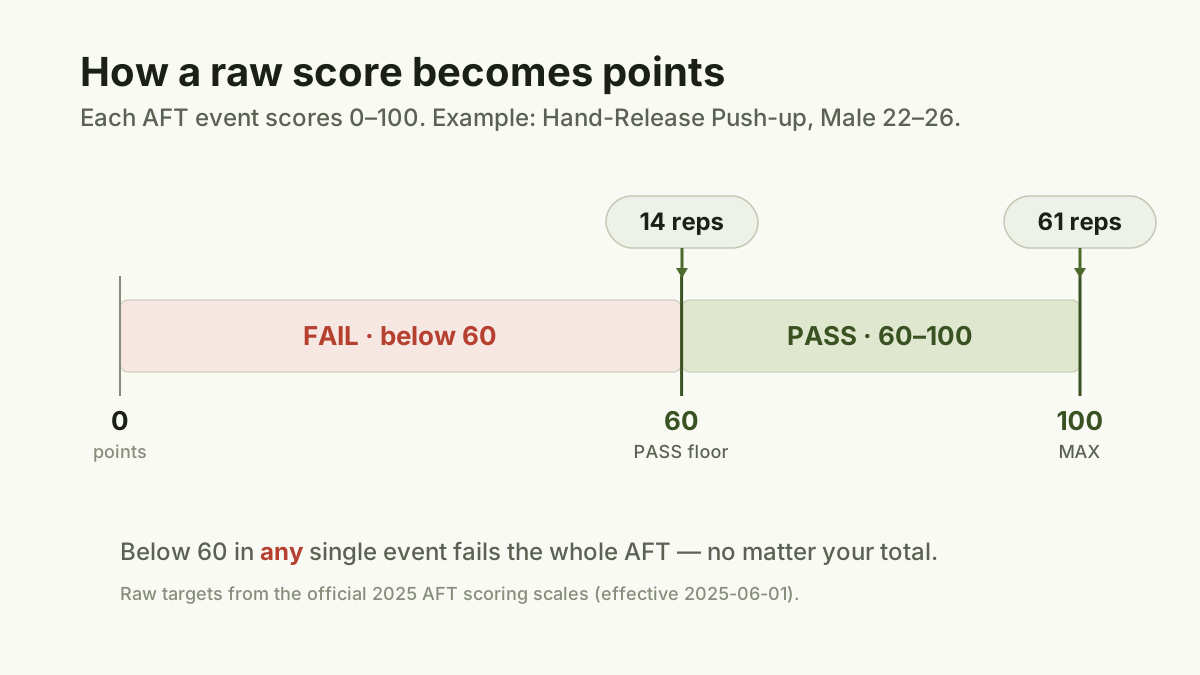
That is the entire scoring logic. The charts below only tell you which raw numbers land on 60 and which land on 100 for your age and column.
The Full Score Chart, Event by Event
The official scales publish a point value for nearly every rep and second, but two rows carry your test: the minimum to pass (60 points) and the ceiling (100). Each table shows both, split by scoring column. MC covers males and every soldier scored on the combat standard; F covers females on the general standard.
Deadlift — MDL (pounds)
| Age | MC pass (60) | MC max (100) | F pass (60) | F max (100) |
|---|---|---|---|---|
| 17–21 | 150 | 340 | 120 | 220 |
| 22–26 | 150 | 350 | 120 | 230 |
| 27–31 | 150 | 350 | 120 | 240 |
| 32–36 | 140 | 350 | 120 | 230 |
| 37–41 | 140 | 350 | 120 | 220 |
| 42–46 | 140 | 350 | 120 | 210 |
| 47–51 | 140 | 340 | 120 | 200 |
| 52–56 | 140 | 330 | 120 | 190 |
| 57–61 | 140 | 250 | 120 | 170 |
| Over 62 | 140 | 230 | 120 | 170 |
The female deadlift max actually peaks in the late twenties — a 27–31 soldier needs 240 pounds for a perfect 100, more than the 220 asked at 17–21.
Hand-Release Push-up — HRP (reps in 2 minutes)
| Age | MC pass (60) | MC max (100) | F pass (60) | F max (100) |
|---|---|---|---|---|
| 17–21 | 15 | 58 | 11 | 53 |
| 22–26 | 14 | 61 | 11 | 50 |
| 27–31 | 14 | 62 | 11 | 48 |
| 32–36 | 13 | 60 | 11 | 47 |
| 37–41 | 12 | 59 | 10 | 43 |
| 42–46 | 11 | 57 | 10 | 40 |
| 47–51 | 11 | 55 | 10 | 38 |
| 52–56 | 10 | 51 | 10 | 36 |
| 57–61 | 10 | 46 | 10 | 24 |
| Over 62 | 10 | 43 | 10 | 24 |
Push-up maxes fall off harder with age than any other event: on the F column a perfect score drops from 50 reps at 22–26 to 24 at 57–61.
Sprint-Drag-Carry — SDC (minutes:seconds, faster is better)
| Age | MC pass (60) | MC max (100) | F pass (60) | F max (100) |
|---|---|---|---|---|
| 17–21 | 2:28 | 1:29 | 3:15 | 1:55 |
| 22–26 | 2:31 | 1:30 | 3:15 | 1:55 |
| 27–31 | 2:32 | 1:30 | 3:15 | 1:55 |
| 32–36 | 2:36 | 1:33 | 3:22 | 1:59 |
| 37–41 | 2:41 | 1:36 | 3:27 | 2:02 |
| 42–46 | 2:45 | 1:40 | 3:42 | 2:09 |
| 47–51 | 2:53 | 1:45 | 3:51 | 2:11 |
| 52–56 | 3:00 | 1:52 | 4:03 | 2:18 |
| 57–61 | 3:12 | 1:58 | 4:48 | 2:26 |
| Over 62 | 3:16 | 2:09 | 4:48 | 2:26 |
The SDC is a timed shuttle, so a lower number wins — a 17–21 soldier on the MC column passes at 2:28 and maxes at 1:29.
Plank — PLK (minutes:seconds, longer is better)
The plank is the AFT’s one sex-neutral event: men and women hold to the identical standard, so a single pair of columns covers everyone.
| Age | Pass (60) | Max (100) |
|---|---|---|
| 17–21 | 1:30 | 3:40 |
| 22–26 | 1:25 | 3:35 |
| 27–31 | 1:20 | 3:30 |
| 32–36 | 1:15 | 3:25 |
| 37–41 | 1:10 | 3:20 |
| 42–46 | 1:10 | 3:20 |
| 47–51 | 1:10 | 3:20 |
| 52–56 | 1:10 | 3:20 |
| 57–61 | 1:10 | 3:20 |
| Over 62 | 1:10 | 3:20 |
From age 37 up the floor flattens at 1:10 and the 100-point hold sits at 3:20 for every band.
Two-Mile Run — 2MR (minutes:seconds, faster is better)
| Age | MC pass (60) | MC max (100) | F pass (60) | F max (100) |
|---|---|---|---|---|
| 17–21 | 19:57 | 13:22 | 22:55 | 16:00 |
| 22–26 | 19:45 | 13:25 | 22:45 | 15:30 |
| 27–31 | 19:45 | 13:25 | 22:45 | 15:30 |
| 32–36 | 20:44 | 13:42 | 22:50 | 15:48 |
| 37–41 | 20:44 | 13:42 | 22:59 | 15:51 |
| 42–46 | 22:04 | 14:05 | 23:15 | 16:00 |
| 47–51 | 22:04 | 14:30 | 23:30 | 16:30 |
| 52–56 | 22:50 | 15:09 | 24:00 | 16:59 |
| 57–61 | 23:36 | 15:28 | 24:48 | 17:18 |
| Over 62 | 23:36 | 15:28 | 25:00 | 17:18 |
The run has the widest pass-to-max window on the chart: a 17–21 male passes at 19:57 but needs 13:22 for a perfect 100.
Your Column: General 300 or Combat 350
Finding your row is half the job. Knowing which total you are chasing is the other half.
Most soldiers are scored on the general standard and need 300. Hold one of the 21 combat MOSs and you move to the combat standard — the sex-neutral MC column and a 350 total — as it phases in through 2026, active component first, then Reserve and National Guard.
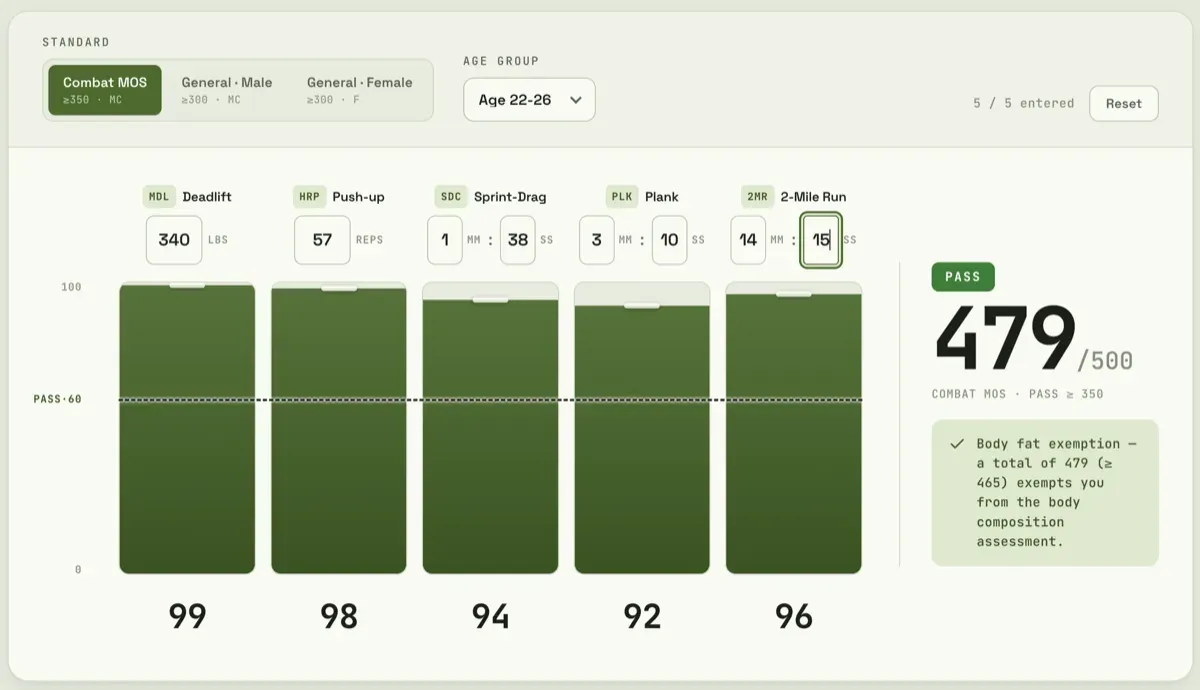
The charts hand you the raw targets, but they will not add five events, weigh your age band, and tell you whether 62-73-88-70-64 clears your line. That part is worth automating. Drop your five raw numbers into the AFT calculator and it returns each event’s points, your running total, and a PASS or FAIL against the standard you pick — the same 2025 scales printed above, in the browser, no sign-up. If you are weighing what counts as a strong result rather than a passing one, what a good AFT score actually looks like breaks down passing versus maxing.
The Two Numbers That Trip People Up: 60 and 465
Two thresholds decide whether your chart-reading ends in a pass, and neither is a column.
60 — the per-event floor. A single event under 60 points fails the AFT outright, whatever the total. This is where strong soldiers lose: they bank a huge deadlift, coast the run, miss 60 on the run, and fail a test they “scored 340” on. Your weakest event, not your total, is the number to defend.
465 — the tape exemption. A combined score of 465 or higher exempts you from the body-composition (tape) assessment for that record period. That is 35 points off a perfect 500 — reachable without maxing everything, but it takes real margin across at least three events.
Once you have found your row, the fastest way to know your real total is to run your five numbers through the calculator, which applies every table above at once.
Common Questions
Are the 2025 AFT scales still current in 2026?
Yes. The scoring scales effective June 1, 2025 are the ones in force through 2026. The 2026 change is not a new set of scales — it is the combat standard phasing in for the 21 combat MOSs, active component first, then Reserve and National Guard.
Do men and women have the same AFT standards?
Only on the plank. Under the general standard, the deadlift, push-up, sprint-drag-carry, and run all use separate male and female scoring. The combat standard works differently again: it applies one sex-neutral column to everyone in a combat MOS.
Is 350 a good AFT score?
350 is exactly the combat-standard passing total, so on that standard it is a pass rather than a cushion. On the general standard, where 300 passes, it is a comfortable margin. Whether it reads as “good” depends on which column and age band you are scored against.
What happens if I fail one event?
Scoring under 60 on any single event fails the whole AFT, regardless of your total. You retest the entire test — not just the event you missed — once your unit’s retest policy allows.